
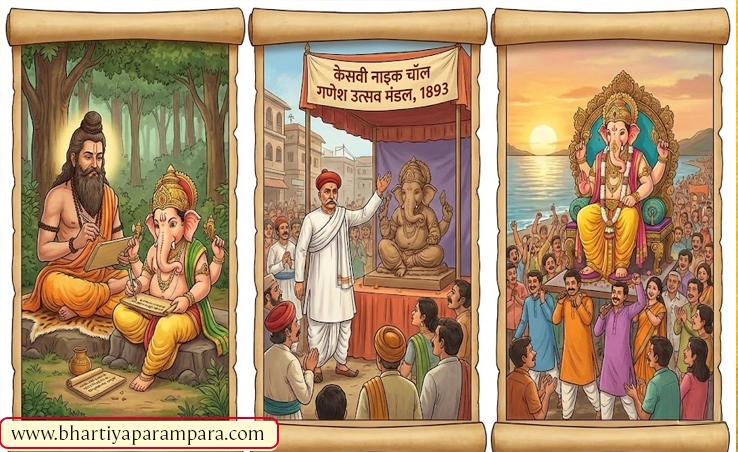
Origin and Significance of Ganesh Utsav — A Story from Mahabharata Era
During the ancient times, Maharishi Ved Vyas invoked Lord Ganesha to script the great epic Mahabharata. Ved Vyas requested Lord Ganesha to be the scribe of his verses. Ganesha agreed but placed one condition —
“Once I begin writing, I will not stop. If my pen halts for even a moment, I will stop writing.”
To this, Ved Vyas replied,
“O Lord, you are the foremost among the wise. I am a humble sage — there may be errors in my verses. Please write only after understanding each shloka and correcting any possible mistakes.”
From that day, on the Chaturthi (4th day) of Shukla Paksha in the month of Bhadrapada, Ved Vyas began reciting, and Ganesha started writing Mahabharata. This continued non-stop for 10 days, and on the Anant Chaturdashi, the writing was completed.
During these ten intense days, Lord Ganesha remained seated on one seat without moving, continuously writing. As a result, his body became stiff, and layers of dust and soil accumulated over him. On the 10th day, Ganesha bathed in the holy Saraswati river and cleansed himself of all the dust and dirt.
Thus, the day when Ganesha began writing — Bhadrapada Shukla Chaturthi — came to be celebrated every year as Ganesh Chaturthi, and on the 10th day, during Anant Chaturdashi, his visarjan (immersion) is performed.
Modern Revival of Ganesh Utsav
Though Ganesh Utsav is an ancient celebration, its public form was revived by Chhatrapati Shivaji Maharaj to promote culture and unity. However, it was Lokmanya Bal Gangadhar Tilak who popularized Ganesh Utsav as a mass movement for national awakening.
In 1893, Tilak established the first public Ganesh Mandal in Girgaon, Mumbai, called Kesavi Naik Chawl Ganesh Utsav Mandal. He introduced the public installation of clay idols of Lord Ganesha for 10 days of community worship.
Today, Ganeshotsav is celebrated in every state, city, street, and home across India with devotion and grandeur.
Spiritual Significance
Spiritually, the 10 days of Ganesh Utsav symbolize a disciplined, devoted life, lived with mind, speech, action, and faith. On the final day, during visarjan, devotees are encouraged to immerse not just the idol, but also all accumulated negativity, desires, and impurities of the soul, leaving behind a purified and evolved self — just as Ganesha cleansed himself in the river.
Ganpati: The School of Divine Wisdom
The revered Lord Ganesha,
Whose presence is truly unique—
In Himself resides the complete
School of wisdom we seek.
His large head teaches us
To keep our thoughts vast and grand.
His long, winnowing-fan-like ears remind us
Not to let idle talk enter our mind.
His single tusk conveys
The lesson of proper and righteous use.
And His small, keen eyes tell us
To examine everything closely before we choose.
His large belly teaches
To digest not only food, but words as well.
His ever-moving trunk guides us
To live an active, purposeful life, without fail.
His four arms represent
Action, service, and helpfulness in every deed.
His mouse as a vehicle teaches
That even a small body can carry mighty willpower indeed.
The axe in His hand symbolizes
Cutting the cords of attachment and desire.
The noose in the other hand reminds us
To keep our goals close and inspire.
His hand raised in blessing tells us
To practice compassion, righteousness, and welfare.
And the sweet modak He holds teaches
To fill life with faith, devotion, and sincere prayer.


Login to Leave Comment
LoginNo Comments Found
Related Articles
Aadi Perukku | Monsoon festival in Tamil Nadu
Why is there Adhik Maah | Mythological base of Adhik Maas
Significance of Daan traditions in Adhik Maas | Purshotam Maah
Ahoi Ashtami Vrat | Ahoi Mata | Ahoi Ashtami Vrat Katha
Akshaya Tritiya | Why is Akshaya Tritiya celebrated? | What is the significance of Akshaya Tritiya?
Ugadi Festival | Why we celebrate Ugadi Parv?
Vakratundi Chaturthi | Til Chauth | Sankat Chauth
Tejadashmi Parv | Teja Ji Festival
Why do we celebrate Basant Panchami | Basant Panchami Festival | Importance of Basant Panchami
Beawar's historic Badshah Mela (fair) | Beawar City
How the tradition of celebrating Bhai Dooj started | Bhai Dooj story and significance | Why we celebrate bhai dooj
Chaitra Navratri Festival| Chaitra Navratri
Why do we celebrate the festival of Chetichand? | Jhulelal Jyanti
Sharad Purnima Vrat Katha | Puja Vidhi
Importance of Sharad Purnima | Goddess Laxmi
Why Chhath Puja festival is celebrated | Who started Chhath Puja Tradition? | Chhath Puja
Why is Satudi Teej worshiped with a sprig of neem? | Satudi Teej
Importance of Narak Chaturdashi, Kali Chaudas, Roop Chaudas, Chhoti Diwali or Narak Nivaran Chaturdashi| Why Narak Chaturdashi Called Roop Chaudas
Sajibu Nongma Panaba | Sajibu Nogama Penaba Festival
Rishi Panchami | Maheshwari Rakshabandhan
Dahi Handi | Why and how is Dahi Handi celebrated?
Jagannath Puri Rath Yatra | Odisha | Lord Krishna
Ramdev Jayanti | Ramdev Pir Baba | Marvad Ra Ramdevra
Know why Dev Diwali is celebrated | Dev Diwali | How the tradition of celebrating Dev Diwali started
Rakshabandhan | What is the logic behind Rakhi festival?
Do not do this work during Shradh Paksha | Pitru Paksh
What is the Ancient Story of Pitra Paksha| Pitru Paksh Katha
Onam Festival | History and Importance of Onam Festival
How often does Navratri come in a year | Importance of Navaratri
Makar Sankranti | Solstice
Navratri Day 5 : Worship of Maa Skandmata, fasting stories, mantras, aarti, bhog and prasad | Maa Skandmata in Navaratri
Navratri Day 9 : Worship of Maa Siddhidatri, fasting stories, mantras, aarti, bhog and prasad | Maa Siddhidatri in Navaratri
Navratri Day 1 : Worship of Maa Shailputri, Vrat Katha, Mantra, Aarti, Bhog and Prasad | Maa Shaiputri in Navaratri
Navratri Day 8 : Worship of Maa Mahagauri, fasting stories, mantras, aarti, bhog and prasad | Maa Maha Gauri in Navaratri
Navratri Day 4 : Worship of Maa Kushmanda, Vrat Katha, Mantra, Aarti, Bhog and Prasad | Maa Kushmanda in Navaratri
Navratri Day 6 : Worship of Maa Katyayani, fasting stories, mantras, aarti, bhog and prasad | Maa Katyayani in Navaratri
Navratri Day 7 : Worship of Maa Kalratri, fasting stories, mantras, aarti, bhog and prasad | Maa Kalratri in Navaratri
Navratri Day 3 : Worship of Maa Chandraghanta, fasting stories, mantras, aarti, bhog and prasad
Navratri Day 2 : Worship of Maa Brahmacharini, Vrat Katha, Mantra, Aarti, Bhog and Prasad | Maa Bramhacharini in Navaratri
Importance of Labh Panchami | Saubhagya Panchami
Karva Chauth Vrat | Why the moon and husband's face are seen in the sieve?
Importance of bathing rituals on Kartik month | Kartik Maah Vrat
How to do ghatasthapana in Shardiya Navratri ? | Kalash Sthapna in Navaratri
Paryushan Parva : Why, When and How is it Celebrated?
Traditions of Holi Festival | How to celebrate Holi
Why do we celebrate Holi? | Importance of Holi Festival
Importance of Hartalika Teej Vrat | Why do hartalika fast?
Guru Purnima | Why is the Poonam of Ashadh celebrated on Guru Purnima?
Why do Gupt celebrate Navratri? | Importance of Gupt Navratri | Gupt Navratri
Why do Govardhan worship? | Why We Celebrate Govardhan or Annakut (Annakoot) Festival
Know why Ganesh ji is called "Ganpati Bappa Morya"? | Ganapti Bappa Morya | Gajanana
How to do Gangaur fast and worship| Gangaur Puja
Ganesh Immersion on Anant Chaturdashi | Ganapati Visarjan
Why do Ganesh Utsav celebrate? | Ganesh Chaturthi
Parivartini Ekadashi | Vaman Jayanti | Impotance of Parivartini Ekadashi
Why we Celebrate Dussehra, Vijaya Dashmi and Aayudh Puja
Measures to be taken on Deepawali | Diwali | Laxami Pujan
Deepawali Puja Vidhi and Puja Stuff | Diwali Puja | Method of Worshiping Laxmi
Why do you celebrate Deepawali? | Diwali Festival of Light
Different ways to celebrate Holi | Holi Colorful Festival
Why the festival of Dhanteras is celebrated? | Dhanteras | Who is the God Dhanvantari?
Kripa kerhu gurudev ki nayi | Hanuman Jyanti
Vat Savitri Vrat | Importance of Vat Savitri Vrat
Mahalakshmi - Festival of Maharashtra
Diwali - Rama Sama | Diwali Festival | How to Celebrate Diwali
Maha Shivratri | Shiv Ratri
Gudi Padwa | Marathi New Year
Pandharpur Wari | Lord Vitthala | Maharashtra
Rama's Shakti Worship and Navratri Begin
Nirjala Ekadashi | Nirjala Ekadashi Katha
Importance of Gupt Navratri
Hariyali Amavasya
Devshayani Ekadashi | Padma Ekadashi
Shri Govardhan Puja and Prakatya | Mathura | Lord Krishana
Shri Govardhan Puja and Annakut | Mathura | Lord Krishana
Jaya Ekadashi | Significance of Jaya Ekadashi
Mokshada Ekadashi Vrat | Geeta Jyanti
Paush Putrada Ekadashi | Paush Putrada Ekadashi Puja Samgri
Shatila Ekadashi | Meaning of Shatila
Significance of Mahashivratri | Maha Shivratri Fasting | Lord Shiva
Mahari Gangaur| Gangaur Puja I Gangaur Vrat
Holika Dahan Festival | Holi colors with life
Sheetla Saptami / Basoda Puja | Sheetla Saptami Puja
Importance of Gupt Navratri
Hariyali Amavasya
Nirjala Ekadashi | Nirjala Ekadashi Katha
Rama's Shakti Worship and Navratri Begin
Makar Sankranti Parv | Festival of Nature | Kite Festival
Maha Shivratri | How to worship Shiva | Twelve Jyotirlingas
Gangaur Festival is celebrated to maintain good fortune
Akshaya Tritiya is a Fruitful Festival
Marriage of Shri Ram Sita | Vivah Panchami
Pongal Festival | How to celebrate Pongal
Hanuman Jayanti | How to Celebrate Hanuman Jayanti
Guru Purnima | Significance of Guru Purnima | Meaning of Guru
Birthday of Goddess Radha | Radhashtami Worship Method
Pola Pithora (Pola) - the important festival of farmers in Maharashtra
Marabat Festival | Marbat - Nagpur's Marbat Festival
Importance of Chaitra Navratri
Vat Savitri Vrat
What is Shraadh? | How do Pitras attain Shraddha?
Paryushan Parva : Why, When and How is it Celebrated?
Why do Govardhan worship? | Why We Celebrate Govardhan or Annakut (Annakoot) Festival
Importance of Anant Chaturdashi | Worship of God Vishnu
The Thread of Trust - Rakshabandhan
Hartalika Teej : Vrat Katha, Puja Vidhi, Significance
Durga Puja: A Celebration of the Victory of Good and Cultural Heritage
Our Folk Festival - Sanjhi Mata or Chanda Taraiya
Sindur Khela
Why do women view the moon through a sieve on Karwa Chauth?
The Beginning of Diwali - Dhanteras
Involve Children in the Country's Culture and Traditions During Diwali
Nag Panchami | नाग पंचमी
Krishna Janmashtami – Significance, Story & Celebrations
Rishi Panchami – A Sacred Thread of Tradition and Love
From Mahalaya to Chhath Puja – The Spiritual Journey of Indian Festivals
Akshaya Navami: Festival of Nature Worship and Amla Tree Rituals
Dev Uthani Ekadashi – A Day of Auspicious Beginnings
Saphala Ekadashi Vrat: The Auspicious Day of Fulfillment and Blessings
Sankat Chauth Vrat – Significance, Story, and Rituals in Hindu Tradition
Traditional Holi Songs and Rasiya – A Colorful Musical Heritage
Akshaya Tritiya: Auspicious Day, Significance, Rituals & Story | अक्षय तृतीया
From Devotion to Science: The Multifaceted Significance of Hartalika Teej
Resham Ki Dor | Raksha Bandhan: Festival of Love, Protection & Eternal Bond
Balram Jayanti : Significance of Hal Shashti & Chandra Chhath
Pitru Paksha: Tradition and importance of Shraddh
Sharad Purnima Significance & Rituals
Deepotsav: A confluence of culture, sociality and science
Jitiya Vrat Katha – Sacred Festival for Child's Long Life
Sheetala Saptami Vrat Katha, Puja Vidhi, Importance
Anant Chaturdashi Vrat Katha, Puja Vidhi, 14 Knots Mystery
Raksha Bandhan in South India: Tradition, Change & Cultural Unity
Maha Shivaratri: Meaning, Rituals, Story & Significance
Vedic Holi: Tradition, Legends & Scientific Wisdom
Nav Samvatsar 2025: Hindu New Year, Significance, History, and Celebrations
Varuthini Ekadashi 2025 – Significance, Vrat Rules & Story
Akshaya Tritiya & Parshuram Jayanti: Significance, Legend and Celebration
Shravan Maas – Worship, Significance & Rituals of Mahadev in Monsoon Month
Ganesh Utsav: Spiritual Meaning, Mahabharata Origin & Modern Revival
Navratri's Kolu/Golu: A Confluence of Tradition and Modernity
Bhai Dooj | History, Significance, and Celebration of Yam Dwitiya
Mahavir Swami Jayanti: Teachings, Panchsheel, and the Eternal Message of Non-Violence
Buddha Purnima 2025: Significance, Teachings & Rituals
Celebrating the transition of seasons - Holi | Festival of Colors, Love & Spiritual Joy
Holi Ki Bhai Dooj – The Festival of Eternal Sibling Love
Dhanteras: A Festival of Empathy, Not Just Prosperity
Lohri Festival: Significance, Traditions, and Cultural Importance in India
Shattila Ekadashi Fast: Significance, Puja Vidhi, Katha & Sesame Remedies
Sawan in Sikh Barahmaha | Spiritual Meaning & Divine Union
Snakes in Indian Culture: Significance of Nag Panchami, Ecological Importance & Snake Conservation
Significance of Bodh Gaya During Pitru Paksha | Pind Daan & Moksha
What is Jivachhraddh? Rules & Beliefs of Self Pind Daan in Gaya
Pitru Paksha & Crows: Spiritual Meaning & Environmental Impact
Durga Puja and Bengal's Cultural Heritage: History, Art & Traditions
Karwa Chauth: Why a Wife Is the Family’s Strongest Pillar | Karwa Chauth Special
Writer’s Other Articles
Bhai Dooj | History, Significance, and Celebration of Yam Dwitiya
Ganesh Utsav: Spiritual Meaning, Mahabharata Origin & Modern Revival
Akshaya Tritiya & Parshuram Jayanti: Significance, Legend and Celebration
Why do women view the moon through a sieve on Karwa Chauth?
Yoga keeps you healthy
Importance of Chaitra Navratri